
https://hbr.org/tip/2025/02/the-power-of-humble-leadership
Subscribe to our newsletter on LinkedIn: https://www.linkedin.com/build-relation/newsletter-follow?entityUrn=7373364855967461376
Check out our website: https://canyouhearmepod.beam.ly/
Thank you for listening to "Can You Hear Me?". If you enjoyed our show, please consider subscribing and leaving a review on your favorite podcast platform.
Stay connected with us:
- Follow us on LinkedIn!
- Follow our co-host Eileen Rochford on Linkedin!
- Follow our co-host Rob Johnson on Linkedin!
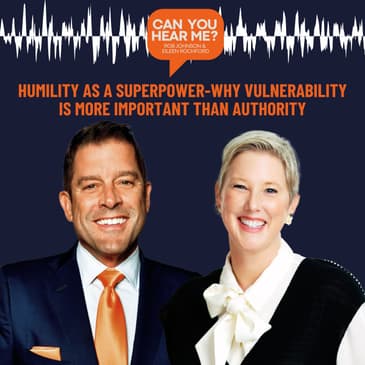
[00:00:20] Welcome to another edition of the Can You Hear Me podcast. I'm Eileen Rochford, CEO of The Harbinger Group, a marketing and strategy firm. And I'm Rob Johnson, president of Rob Johnson Communications. For decades, the corporate playbook told executives that leadership meant having all the answers. The command and control model dictated that you project absolute certainty, filter out personal emotion, and mask any sign of weakness.
[00:00:44] But in the modern workforce, it's sending out a loud and clear message that that era is over and that message should be sent on to the C-suite. That's right, Rob. Today, we are unpacking a paradigm shift that some traditional leaders might find terrifying, but progressive leaders are embracing as their competitive advantage.
[00:01:03] We're talking about humility as a superpower. We want to examine why vulnerability and emotional intelligence outperform rigid authority in driving business results and building trust. And we should also say, Eileen, we are not talking about a feel-good HR trend here. There is hard data proving that leading with humility has massive public relations, internal communications, and bottom-line benefits. Why has the definition of an effective leader transformed so dramatically over the last few years?
[00:01:32] Well, look at what the workforce has been through. A global disruption, rapid technological shifts with AI, and a really big trust deficit. Employees aren't looking for a flawless superhero anymore. They're looking for an honest human being. Now, according to the 2024 Edelman Trust Barometer, employees expect their CEOs to be transparent and personally visible. In fact, trust is now a primary driver of employee retention and brand loyalty. When a leader acts as if they know everything, that breeds skepticism, not safety.
[00:02:02] That's right. And I think those trust numbers have, at least in terms of expectations of CEOs, in other reports like out of Annenberg and places like that, they just keep showing that trust is the bedrock of all communication. And if you can't be humble, I guess, when it comes to humility and show those aspects or dimensions of you as a leader, it is really hard to trust you.
[00:02:30] I think that's just general or true in general of human relationships. I'm sure you kind of have a sense of that too, Rob. But in particular, when it's people you look up to, if you will, people who you expect to lead you. I don't think that you can do that or have the ability to motivate and lead people unless there is a very strong bedrock of trust, you know, underpinning everything that you do and say.
[00:02:58] I agree. I think it's important to realize that it felt like before COVID, there was the, hey, I'm a CEO and I drive revenue, etc. And then COVID hit and it was much more this way where it was collaborative. It was somebody paying attention. It was somebody who was being humble. It felt like that was a real trend. And then it felt like once COVID was well in our rear view mirror, it kind of got back to, you know, do as I say.
[00:03:24] And it's nice to see as we're sitting here in 2026, that this is a thing that people expected. And I think it's also driven by generations as well, you know, because younger people have different expectations for what they want out of their leaders. And more and more of them are, you know, they're dominating the workforce, Gen Z and millennials. Yeah, no doubt about it.
[00:03:44] But I always look at kind of what happened to all of us back in 2020 through, you know, 21 and somewhat into 2022 during the pandemic as like the great equalizer. You know, all the kind of that there was no, you know, person behind the curtain anymore. We all look the same in our home environments and on Zoom and, you know, six months of not getting your hair colored or your eyebrows, John, or you name it.
[00:04:11] You know, we all kind of had to just be like, this is who we are as human beings. And it's okay to show people we work with. That's who we really are. It started something that I don't know that you even with return to office, even with, you know, a little bit more of that elements of command control and ripping away some of the better benefits and things. It just feels like that part. There's no one doing that.
[00:04:33] So leading, moving forward, every leader has to recognize that that, you know, the carpet was pulled out from under us in that regard. And people want you to relate to them as a human being and demonstrate that humility. And you'll be far more successful if you're just open to doing so. That's my opinion again. Observe observations from. It's just your opinion as a CEO. So that's just my opinion as a CEO, because you're driving culture at the Harbinger Group.
[00:05:03] Yeah, you're right. You're right. And it really did force me to do things differently, even though we were already a fully remote company. There were very hard, real conversations during that era about, you know, life is scary. Things that you normally never brought into the workplace. There was far more real talk about how we're feeling, how we're doing, how we're coping than I'd ever had in the workplace, no doubt. And a lot of that remains.
[00:05:30] We may not spend as much time doing those conversations or having those conversations. Fortunately, far more open to it than we would have been if that hadn't happened to all of us. So the frequency has gone down a little bit, but in your world, it's still there. And I think it should be there. Yeah, I agree. We totally agree on that point. It's just, like I said, it was kind of like the curtain was drawn back or the rug was pulled out, whatever you want to say. And not all of that can be undone.
[00:06:00] And not all of that should be or is, you know, bad. But there is more of a balance back in place where it's like, okay, you know, we do have to kind of tough it out. We can't stay in that place of kind of hardship forever. We all have to move forward and find a way, you know. There's a little more of the digging deep in the last several years than there were certainly from the years 20 to 22, digging deep when things are harder. Yeah. We're all getting used to it again. Yeah, I would say. Yeah.
[00:06:30] Interesting time. Well, here's another point that we can talk about in the same vein of the theme of the show. If your external brand promises empathy and innovation, but your internal culture is run by a rigid authoritarian boss, that disconnect is going to leak out eventually. There's no doubt about that.
[00:06:49] So Harvard Business School professor Amy Edmondson, who pioneered the concept of psychological safety, something we've talked about quite a bit on this show and thankfully has talked about a lot more in the workplace than it was 10 years ago. She has proved this heavily in her research. So I'm going to quote here. When leaders admit they don't have all the answers, it gives permission for others to speak up. Experiment and flag mistakes early. Who doesn't want that, right? Everybody should want it. Absolutely.
[00:07:19] So if your team is too afraid of your, air quotes, authority to tell you that something's going wrong, a strategy is failing, you are totally flying blind and unnecessarily so. Every single person who works in your organization could be the person who keeps you from catastrophe. If you're allowing them through your example to feel that they can speak up. And that's, I don't know, anybody who doesn't recognize that.
[00:07:46] And show a little humility that, gosh, maybe I should take 10 steps back and examine how am I conducting myself? How much? One of my favorite things, Rob, is in fathom or tactic, you name it. Any of those awesome, you know, note taking and more AI assistant tools. When they show you who talked the most in each of the meetings. And it says, you know, somebody talks 72% of the time and the 10 other people only talk the balance. And oh my God, is that enlightening?
[00:08:15] So if you want a reality check and recognize, are you setting the tone that you're the only person who can talk? Maybe check out those meeting reach outs. Yes. They're very sobering because it's true. I mean, there's no getting around it. It's real. It's data. But it's also, I will say this on the flip side there, it is incumbent upon others to, you need to have created that safety that we talked about, right? Yeah.
[00:08:43] Amy Edmondson talks about all the time. Yeah. Harvard. But, you know, if I'm in a meeting, I don't want to talk all that. I don't want to. I mean, if nobody's going to, you know, chime in or whatever, I'll keep talking. But I prefer others, you know, and it's listening and it's asking questions and it's, you know, what do you think? And that sort of thing. But it really is up to those folks to jump in, but they have to feel comfortable to jump in. So there's the rub. Yeah.
[00:09:07] And I think it's also incumbent upon leaders to learn the techniques that invite people into conversation and not just expect them to jump in. Why don't they talk more? Why don't they contribute more? That's so infuriating. Well, if they're not, then you probably haven't done a part of your job. Go and learn, you know, the exploratory questioning techniques, not show up to every meeting with here's what we're going to do. You know, learn how to use collaborative language.
[00:09:33] Make an effort to do that and you'll change the entire dynamic on your team or, you know, in your whole organization. And others will model that kind of behavior. We've talked about this as well previously on one of our shows, Rob, using exploratory questions. And just that technique alone invites people into the conversation. And doing so in a way that doesn't put them on the spot is critical, in my opinion, because I personally experienced that this year.
[00:10:02] Where I didn't realize that my exploratory questions were a little too pointed. And it was having the opposite effect than what I wanted. And one of my team members was really totally, you know, I wouldn't say brave enough, but took it upon themselves to say, hey, I think part of this is because the reaction is that they're thinking they're supposed to have the answers and they're being put on the spot.
[00:10:26] So I had to go and, you know, dig into this and talk to some of my better, you know, mentor friends and get better advice about how to do it. Where it was more not like, what do you think? Well, not that I say it that way, but that's how it was received. And it became more about, you know, I've heard you or seen you do this in your role. I'd like to hear more about what you're seeing while you're conducting that research or outreach or monitoring, you know, because these are more junior people.
[00:10:53] And taking the time to learn a different way. And first of all, being open and not saying like, well, it's on them. They should show up with whatever. But to me to reflect and be like, whoa, because I totally did not expect to hear this was super sobering. But I took the time. I was like, well, I've got to change this. This is really not good. So taking the time to go and find out, OK, these are different techniques I can try.
[00:11:20] And, you know, it presents the questions in a far more collaborative, you know, experience based way where that helps my team members feel like, all right, she's got me on solid ground here. This is something that I've done and I know where, you know, I am now and I can draw from my expertise and contribute. So it became a very different dynamic. And it's stayed that way. This was months ago.
[00:11:45] And now I look at those meeting recaps and I'm thrilled because I'm like, I'm talking like 35% of the time. It's a totally different thing. It's great. Well, one of the weekly meetings I have with some of your folks from the Harbinger group, it's so instead of surprising somebody or here's what it is, they know everybody in that meeting knows that each person has to report on something. And so, you know, I may have their names in parentheses or, you know, various other things. So I don't, I'm not, I'm not pulling a fast one on them.
[00:12:14] I'm not surprising them. I'm also looking to talk less to your point about fathom and tactic. And it seems to work. And everybody understands expectations and understands that they have to contribute in certain ways. Ways, by the way, where they're have expertise in. So it's not like I'm going to ask them something, you know, they're like, I have no. It's something that they know, but they know I need them to contribute.
[00:12:36] And so I think that's another, you know, kind of taking that a step farther is the expectations that you provide while not surprising them with something, but letting them know, I need you to weigh in on this. You're going to weigh in on that. Somebody over there, you know, everybody is going to have a way to contribute. And it feels more like, you know, feels more like a team when I'm not talking 70% of the time to your point, but 35, that's way better. That's way better for everybody.
[00:13:03] So let's dig into these numbers a little bit more, because I know some old school skeptics who might be listening are saying, oh, vulnerability, that sounds like weakness. And it is not. The data tells a really different story. So a major study published in the Journal of Management, research on expressed humility and leadership has shown that when leaders display humility, meaning that they acknowledge their limitations, spotlight team contributions, and are open to feedback.
[00:13:29] It correlates directly with higher team engagement, better job performance, and significantly lower turnover rates. This can't be a surprise. But if, you know, you're in HR, I mean, listen, retention, recruitment and retention, man, that's it. You don't want, you want people to enjoy the culture that they're in and seeing that they have a seat at the table, not only a seat at the table, but they, their opinion is valued when they're sitting at the table. Yeah, yeah, yeah. You would hope that this research isn't surprising, but it may be.
[00:13:59] You know, again, some people are just kind of superset in their ways. But those who are doing really well today as leaders are making a habit to acknowledge contribution in particular. Nobody does anything alone ever, no matter how great you think you are. And believe me, Rob, I think I'm pretty great. Oh, you are. You are. I think you're current. I just needed to hear it. Thank you. I'm totally sure.
[00:14:27] Yes, we all think we're great, but nobody, myself included, ever gets anywhere by themselves. So never forget that. You don't have to be like, do it every single day, every, you know, hour. But you should do it often as you can when it's really meaningful. It's going to land great. It just, and it reminds you to just that you're like, you're bringing people along with you and you're being brought along too. Yes.
[00:14:55] So much of the time, you know, I always say if I spend a day at my job and I haven't learned something, you know, new and surprising, then I didn't do my job really well. And it wasn't because I didn't go out and find something new, but I didn't create an environment where a team member can, you know, bring new things to me that I get super excited about. That's not doing well, in my opinion. So, but this data is really interesting.
[00:15:21] I think people should also just embrace the whole, you know, acknowledge your limitations. It's how exhausting it is to constantly think that you're the only person who can do something and that you've got to like pull it all. And, you know, more and more weights are being thrown on the sled that, you know, you're the dog pulling. That's crazy if you're going to behave that way. I mean, no, just you have to, for your own good health, recognize your limitations, but also acknowledge your team.
[00:15:49] Here's where my expertise ends. Here's the massive role, you know, you, you and you will play in the success of this, you know, initiative, effort, whatever you want to call it. Because then it's like everyone has, when everybody has a stake, it feels like they have a stake in the, and it's not like the stakes are high. I just mean like you've got a role and you're contributing. The entire dynamic just changes. Everything feels so good.
[00:16:15] So like pause and just think about this and remember you're falling back into old behaviors and thinking that you're the only dog pulling that sled. You're dead wrong. It's time to just, you know, acknowledge your team again, bring them into the fold. Well, you've given them what you're talking about, Eileen. You're giving them hope and you're also energizing. And those are things that everybody needs. And again, it doesn't cost anything. It's real simple to do.
[00:16:40] And wouldn't you rather have everybody, you know, kind of clicking on all cylinders when you know that they can. And by empowering them in that way, that's what you're doing. Yeah. Yeah. Okay. So let's, let's talk about a few ways where, or to do what we're talking about in more practical language. So it starts with changing your language.
[00:17:01] And I've talked about a few of the ways to do that and exploring, you know, different ways to use your words, to bring people into conversations in constructive ways where they are on solid ground and contribute. Super important. So things like replacing, here's what we're going to do with, here's the challenge we faced. Here's how I think we should approach it. And I know there are things missing here. Y'all are just as smart as I am. Jump in. What, what needs to be on this list? That kind of stuff.
[00:17:29] But that simple phrase, what am I missing? It invites collaboration and shows you value your team's expertise. And that's kind of step one. You know, if you're not, you got to show them like you value what they think and you know they have great contributions to make to make them feel comfortable to do so. Also just think about don't just share, you know, the big wins, kind of data rundown.
[00:17:55] Run down, say in your quarterly briefs or your town halls or whatever it is that you do. Think, oh, all right. But in this context, maybe things didn't go so great this time around and you're sharing data that might not be what everybody wants to see. Well, that's a great time to share a failure. When you fail personally, this is what happened to me. This was a really hard failure that I experienced. And here's what I learned. Here's how I moved forward. Here's how it shaped how I work with you all today.
[00:18:25] That kind of thing. Connect your own experience of failure because then they're like, you know what? All right. If that happened to you and we're all, you know, you're as successful as you are and we're all doing pretty well, even though this quarter didn't feel great. We can get through this. This is totally doable. And that's the message I think every great leader wants to send. So that's one way to think about it. Largely because when you humanize yourself, you build basically this like bridge of connection with your workforce. It just gets stronger and stronger the more that you're willing to do that.
[00:18:54] And when you talk about mistakes, it's not fatal. It's just a mistake was made. And I talk to execs all the time about it. People should be able to say, I made a mistake. I know a lot of younger workers want to show everybody how much they know. And so they never make, I never make a mistake. It's okay to make a mistake because when you learn from those mistakes, then you don't repeat them. And if you're sharing a moment where things didn't go well, here's what we learned from it.
[00:19:20] That ensures that you're not going to repeat that mistake again. Yeah. Or people that are aware of it, the people that are aware of it, all of a sudden you're part of the solution. They may not have even made the mistake. It might've been you, but because you're sharing that story with them, they are certain to not make it or hopefully not make that mistake. Totally. Yeah. So nobody can pretend that they haven't had failures. That's just ridiculous. And the more that you kind of lean on that and they're like, you know what? I'm real. I'm human too. And why do I know what I know today?
[00:19:50] It's because I tried a million things and half of them totally failed. But from every one of those experiences, I extracted some knowledge, you know, which led me to this point and to this point and to that point. So we all have them. Why try to hide them when you could get what we've just described as such valuable knowledge out of them? It might not even be a mistake. It might be a shift in tactics.
[00:20:13] And the great thing about working on projects that aren't these legacy projects that were created in 1950, you know, oh, we've done it the same way forever, is that you can change your tactics. And so it's not even a, we made a mistake. It's here's what we learned from going down this road. And based on Intel analytics, you name it, we're going to shift things. So it doesn't even have to be a mistake. It could just be a, here's what I learned that we're going to shift tactics. And I always love being parts of projects where it's okay to do that. Oh, yeah.
[00:20:42] I have to go have 48 committee meetings about it. We can have a couple meetings and then we can implement it and then we can see how it goes. I think that's important too. So the final thing that we're going to bring up today, there's a lot we could talk about, but the final thing is prioritize active listening over active talking. The best communicators aren't the ones delivering the most booming speeches, but they are the ones asking the most incisive questions and truly absorbing the answers. And yes, I'm going to promote chapter two of the book, Over Communicate.
[00:21:13] To over communicate, you must first listen. And we talked to Rich Jernstedt, who's a friend of the program, former, you know, an agency guy, longtime agency exec here in Chicago. And that is so important. And out of all the chapters that I wrote, that is the one that I spend the most time trying to implement in my own life. Hey, you do talk a lot, Rob, but why don't I ask you questions? What about you? What's going on with you? Give you a chance to do that.
[00:21:39] I really firmly believe this needs to be part and parcel of everybody's strategy when it comes to interpersonal relationships. No doubt about it. Because if you're not listening, you're not learning. How can you possibly learn something if you're not engaged in hearing what your teammates or others at work are bringing to the table? So that's one way to look at it. Closing your mouth, opening your ears is often more powerful than being the person who tries to look like they have all the answers.
[00:22:08] And doesn't it make you, well, it makes me, I don't want to put words in your mouth. It makes me a little nervous when I come across an exec who's like, I asked questions, but I already knew the answers to all of them. And I'm like, that's not really the point here. The point isn't to challenge your people and then have them give you the answer you know the answer to. Because you're on high, you're a C-suite executive, for instance. There's no way that you have the pulse of the organization.
[00:22:36] You know exactly how it's going. Because those people that you may be asking questions of may be closer to the customers and the clients than you are sometimes. And so if you think you know everything, take a break. Yeah, that's right. Yep. Think again. Right? Okay. Well, that was great. I think that's going to wrap it up for this awesome topic today. Thanks, everybody, for listening. I'm Eileen Rochford.
[00:22:59] If you would like to comment on our show, Can You Hear Me or suggest a topic, please contact us on our Can You Hear Me LinkedIn page and where we can take your questions anytime. We'd love to hear from you about topics that you want to cover. You can also check out our newsletter on LinkedIn, which has become a phenomenal recap, not just of our shows, but of related articles and resources. And that is all thanks to Olivia Sawakee, who is amazing.
[00:23:29] So we can't record the show without giving a nod to our assistant producer, Olivia. She's the best. We appreciate everything she does. That's right. Great. And on that note, we also have to say thanks to our great audio engineer, Declan Beyer. You are the best. And we can't do the show without you either. Thank you. Thank you. Both of them are expressing gratitude. Oh, you're right. Showing humility. We talked about it for almost 30 minutes, and now we're putting it into practice.
[00:23:59] Look at that. Look at us go. I did, too. I'm Rob Johnson. If you liked what you heard, please consider giving Can You Hear Me a positive review wherever you get your podcasts, such as Apple or Spotify. It really does help other listeners find our podcast. And please check out our website. Yes, we have a LinkedIn page. We have all sorts of things with the newsletters Eileen mentioned, but we have the website at canyouhearmepod.beam.ly. We'll leave that in the show notes, and we do thank you for listening.