
How to Become a Reiki Master: https://www.reiki.org/articles/becoming-reiki-master
Overcommunicate: https://www.amazon.com/Overcommunicate-Business-Executives-Aspiring-Leaders/dp/B0GWQ9XJNP
Subscribe to our newsletter on LinkedIn: https://www.linkedin.com/build-relation/newsletter-follow?entityUrn=7373364855967461376
Check out our website: https://canyouhearmepod.beam.ly/
Thank you for listening to "Can You Hear Me?". If you enjoyed our show, please consider subscribing and leaving a review on your favorite podcast platform.
Stay connected with us:
- Follow us on LinkedIn!
- Follow our co-host Eileen Rochford on Linkedin!
- Follow our co-host Rob Johnson on Linkedin!
[00:00:19] Hello everyone and welcome to another edition of the Can You Hear Me podcast. I'm Eileen Rochford, CEO of The Harbinger Group, a marketing and strategy firm. Rob Johnson And I'm Rob Johnson, president of Rob Johnson Communications. You know, many bosses thrive on ensuring that their direct reports adhere to their management style. But what if you could get more out of them by being an adaptive leader and playing to their strength? That's meeting them where they are. And it's chapter eight of my new book, Overcommunicate, a guide for business executives and aspiring leaders.
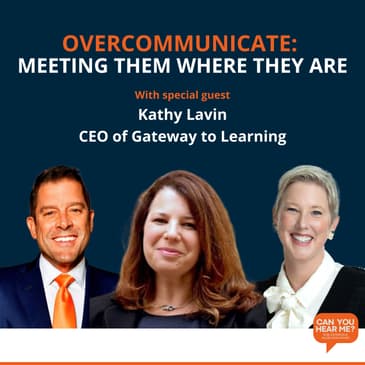
[00:00:47] And to discuss this with us today at greater length, we are joined by Katherine Lavin, CEO of Gateway to Learning, a Chicago not for profit dedicated to providing life skills, job training and employment opportunities to adults with intellectual disabilities. Kathy, welcome to the show. Thanks for being with us today. Thanks, Eileen and Rob. Thanks for having me. I'm very excited to be talking to you today. Yay! Well, yes, very much so. Thank you.
[00:01:15] So, I just want to let our listeners in on your secrets about yourself, Kathy. Just kidding. Your backstory. What? Tell us who you really are, how you got to your position today and what brought you to Gateway to Learning so everybody can just understand you a bit more before we dive in. Yeah, sure.
[00:01:37] I would say that in a nutshell, I've been in the nonprofit space for almost 40 years. I know that's hard to believe, but it's been almost 40 years. No problem.
[00:01:53] And from every, I've done everything from being in program, you know, supervising line staff to being a staff educator in New Jersey, coming here to Chicago and getting my MSW, doing research at UIC, being a community outreach director, being in development, all of that, all the way up to now CEO.
[00:02:16] And I will say that despite all those hats and roles, the thing that has influenced me most is being a mother. And particularly to my soon-to-be 30-year-old, who's my oldest, who has Down syndrome. So, I guess you might say it's been divine intervention to bring me to Gateway to Learning. It really is. And you're the perfect person to be there.
[00:02:41] For the listeners that may not know, we've been friends for more than 25 years and have connected with a common bond because Emily and Edward, my brother, both have Down syndrome, as you just mentioned about Emily. But as I was writing this book, and I was looking to find the perfect people for each chapter that I had an idea for. And reminder, Eileen is chapter nine, everyone communicating in a remote working environment. So, I have two subjects of the book that are on this podcast today.
[00:03:09] I was able, though, Kathy, to watch you with your team on various projects that we've worked on together over the past few years. And I really did appreciate your collaborative approach and the fact that you got the most out of people by tapping into their personality. In other words, you're meeting them where they are. So, that's the name of the chapter. The minute I realized I wanted to focus on that subject matter, I was thinking, who would be good to do that? And you immediately came to mind. So, I know what it means to me. You've read the book.
[00:03:38] What does it mean to you to be an adaptive and adaptable leader? That is a great question, right? And, I mean, I think you said it perfectly. It's meeting people where they are. But what that means is really looking at what their strengths are, what they're good at. If they're in the right positions, what's the capacity need for the organization?
[00:04:04] Gateway, I think I've shared that I came in at a very turbulent time for the organization. The former CEO had passed away. And I think coming in and saying, okay, what does this organization need? What do all the stakeholders need? What do the families and the people we support really need? And how do we meet that?
[00:04:30] And then looking at the team and saying, is this team, you know, the right team here as we move forward? Is it, is, do people, do people feel hurt? Do they feel respected? And I don't know, looking at other people's, just what they're good at and responding to that and what they need support with, right? So, like if you're working with a team member, what kind of supports do they need?
[00:04:57] Do they need, you know, different people need different feedback on and different frequency of that feedback and different types of feedback. And some people are just like, you know, head down, let me know what I need to do. And others just want more positive reinforcement on a daily basis. So, you know, I think it's being able to shift and look at that and being flexible in who you are as a leader as well. So that's the overview and the main part of that.
[00:05:25] I mean, I think, I think the other experience I have is really, you know, we talked about Emily a little bit earlier, but, you know, Emily not only has Down syndrome, but she has what's called speech apraxia. So she is, I guess, in street terms would be nonverbal, right? So you'd say, well, she's nonverbal.
[00:05:46] So, you know, communication has become really important in my life personally and also in my professional life. So, you know, Emily does not communicate the way everybody else communicates. And when you look at body language and how much communication is really nonverbal, then, you know, you're really looking at how, what is this person communicating? How are they communicating?
[00:06:13] And how am I interpreting what they're saying and responding appropriately to that? And I think just having raised Emily for 29 years, I think that she's actually giving me that skill and that practice on a daily basis. That's fascinating. I just keep thinking about how did you acquire these skills? And there you just, you gave me an inside view. I had no idea that that would have been the source for you. That's fascinating. Yeah.
[00:06:39] I, there's also this background of, of the social work aspect. And I think that as a both, and I don't know, Rob, if you even know this, that I am a Reiki master. Yeah. So yeah. I didn't know that. I only learned that when I interviewed you for the book though, out of all these years I've known you, I did not know that. Yeah. And then we started talking about, you know, interviewing for the book and I was like, I did not. Yeah.
[00:07:04] So just kind of this whole like experience of being a social worker, you know, first and foremost, which has this whole background about the theory, you know, social work theory is saying, okay. You know, if you make change on one, in one variable in a system, whether that system is internal or, or familial or in a couple or in a team, right.
[00:07:29] When you, when you change a variable within that system, the whole system changes. So, you know, you're looking at, you know, are you supporting one particular staff person at a time, right. That creates change within the system. And so that there's that social work theory.
[00:07:45] And then you add this element for me personally about, about being a Reiki master, which is all about, you know, source and connectivity in our humanity and our, but more than that, it's about our spirit and our soul and how, and how we're so connected. And I think that, that leaders in general are afraid to get into that level about what their employees really need on a, on a human level. Right.
[00:08:11] And I think that that's, that's part of that adaptability, right. And just meeting people where they are. Do you mind if I ask about how you draw upon what you've developed as a Reiki master kind of in your workplace? Can you, can you think about not specific examples, but just in general things that, that maybe came from there and what, what are they and how to use them? Sure.
[00:08:35] I mean, I think that again, I think that as a Reiki master, you know, that everybody there's an energy or it's like the force, right? I mean, it's like, there's energy that as Yoda says surrounds and is in us and connects us all. And I think that, that each individual has their own energy that they bring to an organization, but the organization has its own energy. Right. So I think it's just cultivating that energy. Um, and ideally in a positive way, like where are people growing?
[00:09:05] How are they growing? Are they passionate about what they do? Right. That's all part of the, your, your soul language. And if you're not passionate about what you do, then it's going to be reflected in your, in your day-to-day job performance. Do you bring the energy? I know you bring your energy that you were just talking about there. Yeah. But do you think because you're the leader, you were talking about the organization's energy.
[00:09:25] The organization has energy because it's helping people that really need help people with intellectual disabilities, but also in your own contribution, because you have those values, do you think that your energy, okay, here's Kathy at work, but also because you're the leader that, that you give the organization a different kind of energy than it normally would have had, which would have been a good one anyway. I do. I mean, I can't separate that for me. I mean, it's so, it's so innate in who I am, just like being a mother of, of an adult daughter with Down syndrome is innate in what I do.
[00:09:55] I mean, it's, I cannot separate that. I mean, I think that's, that's part of being an adaptable, adaptable leader is saying, okay, this is my authentic self, right? I, I have to be true to myself and who I am. Does it mean I'm, I'm, you know, perfect? No. Does it mean that I'm flawed? Sure. We all are, we all, we all, all are human. And so, but absolutely. I mean, absolutely. You know, it's part of this like thing where you do, you know, I wake up every morning, I do a gratitude practice.
[00:10:24] It's all just part of the whole philosophy around not just Reiki, but around gratitude and, and, you know, blessing things as you, you know, come to work in the staff and the, and, and even blessing what I, what I, you know, and, and asking for support in, in communicating. You know, what is, what does the staff need to hear today? You know, am I present? Am I present?
[00:10:48] You know, am I, am I so distracted by so many other things, you know, like, you know, you walk down the hallway and people are like, I mean, there are days that I'm walking down the hallway and my head is like in the, you know, not in the clouds, but it's like, it's like so focused on my to-do list and what I have to do. And someone will be like, hello. And I'll be like, oh my gosh, I'm so sorry. I'm, you know, and, and to be say, to say, I'm, this is me. Like sometimes I get so focused that I don't, but also acknowledging that person needs that eye contact.
[00:11:17] They need that, that, that hello. And I have to be mindful of some people on my team need a good morning every day. And some people don't. Right. And I have to be like, okay, get your head, get your head out of the to-do list and, and, you know, respond to people. Be present. I was just about to say being present that how much of an energetic impact that has on yourself and everyone around you. And then the ultimate, you know, organizational energy. Yeah. Just that thing alone can have such a, an immense, immense impact.
[00:11:47] It's fascinating because I'm also thinking about how, you know, we talk so much about culture and what a significant role leaders play in culture. Now you have me thinking about energy and that's an entirely different element of an organization. That's, it's fascinating because nobody owns the energy, right? Everybody owns the energy. Everyone co-creates the energy. They create it. Yes. Co-created. So if someone comes in and they have, they're in a bad mood, right?
[00:12:15] What happens to the rest of the team? Right? So how do you respond to that? You know, it happened just today. You're like, okay, you're having a tough day. Come into my office, take a beat, you know, and asking those questions. Do you need space? Do you need quiet? Right? Do you need to take a break? What is it that you need? And what can I do to help provide that for you? Right? And then people, right? They're strengthened. And then the energy of the organization of the day changes, right?
[00:12:45] So, and then the organization. So, oh yeah, it is, it is a thing. It is real. So we're talking about adaptive leadership and meeting people where they are. Why is this type of leadership so crucial for you and for, you know, your entire team at Gateway to Learning? What do you think? Why is it the right one for you guys, Kathy?
[00:13:08] I think that, again, I think going back to where my origin was in 2018 when I joined the team, right, is coming in at a time when there was such grief. I mean, talk about the energy. I mean, there was grief and there was confusion and there was turmoil and just being, again, present to what the organization was experiencing as its own being, right?
[00:13:38] And then, and then saying, you know, how do I help lead and shape that? And, and again, meeting people where they're at. And so now I'm going to ask you to rephrase that question again. That's okay. Okay. I was just kind of wondering if there's, it feels like this style is so vital to how you personally lead and how your, and what your team, what your organization needs collectively and from you.
[00:14:07] And why do you think that is? You know, I don't know. I think, I think so much is about being mindful and being present and being self-aware of who you are. I think that, you know, this is my authentic self and maybe it's age. I don't know. You know, maybe it's wisdom. Maybe it's, you know, age again. Like I don't really, you know, but just being saying, okay, this is what I've learned. And I've observed so many people, right?
[00:14:36] Different leaders throughout, throughout my day and in nonprofit. And I, and I think that, you know, adapting qualities of other people and seeing where people are successful is, has been key. And also seeing where people were not so successful and saying, you know what, that first of all, they're, what they are reflecting in their actions are not what I value. So again, holding true to what I value and my own authenticity, I think is, is really key. Right.
[00:15:03] So, um, I think that adds to the mindfulness and the presence, um, of being a leader, particularly for this organization that has gone through so much change, um, in the, in the last eight years. So, yeah. I think you should give yourself a little more credit. You could say it might be age or wisdom, but it's probably wisdom. You should. That's yeah. That's how you need to coach. It's all wisdom. Mainly. It's all wisdom. Yeah. I'm a, I'm a crone. No. Well, you know, Kathy, sometimes we hear leaders or even coaches talk about treating
[00:15:33] everyone the same. I got to treat everyone the same, but even though you have principles and values for the organization, the ones that you help set the energy that you bring, you really do have to treat everyone a little differently. I think that's pretty obvious here in this discussion. Does that ever confuse members of your team? Like, well, you didn't treat him like he did her or vice versa. Does that ever, does that ever come across or is everybody well-versed enough in the way that you do things to understand he has to be used there? What is it? Yeah. I think it's a little of both.
[00:16:02] I mean, I think that one of the things that we value is person-centered supports, right? So for the people that we support with intellectual disabilities, it's, it's really this philosophy of being person-centered. So in general, our program is focused on being person-centered and everything has to be somewhat individualized, right? So I think they understand that as a whole. Doesn't mean that things don't come up, right?
[00:16:27] So I think that it's kind of like what I told my kids when, when they were, when they were little and they would come home, you know, Saturday morning and they'd be like, well, my other two kids would be like, why does Emily not have to do all these chores? Why does she only get one chore and we have to do four chores? You know, well, I don't understand that. And I'm like, look, hold on one second. What's fair is not what's equal. So what's equitable is not what's equal.
[00:16:54] I mean, it's not, and it's, and it's hard to wrap your head around that. I think certainly when you're, you know, six years old or seven years old and you're like, well, my, you know, I got four chores and she's got one chore, you know, it's not right. Equity is not, is not equal to all things. And so, so just being mindful of that. And, and I think that at times I've seen that played here, like in like transparency, right?
[00:17:23] So you'd be like, okay, well, I want to be transparent about everything, you know, as much as I can. And then people are like, well, you're transparent about this, but how come, you know, how come, you know, you're not calling people out on, on their, you know, their lack of job performance. And you say, well, you know, how do you know, you know, or why does some person get to leave early or one person gets to come in late? I, I can't be totally transparent around those things. Those are, those are, you know, those are confidential things.
[00:17:51] So I think sometimes, particularly when you have a multi-generational, you know, staff that some people understand, some people don't understand. I think there's this whole thing around, you know, transparency means that I should know everything that happens all the time and that, and that, you know, what's fair is not what's equal. So, yeah. Yeah. That's, it's so fun when we, when I talk to leaders with Rob on the show, leaders like you, and I just, I hear so many of the same things that I grapple with myself, but it's a, it's affirming.
[00:18:21] It is, it is. Um, I'm curious, Kathy. So some people listening right now might think, well, gosh, that's, you know, kind of pushover leadership, this whole, you know, being, you know, nice here, nice there. Yeah. I don't think that's the case at all. Um, there, there has to be times in your position where you have had to be just firm and hold that line. Um, and so when, when do you play that card? When do you find that that's an absolute must for you?
[00:18:51] At the end of the day, I mean, absolutely. There are definitely those moments that I, that I feel like, you know, just don't, don't, um, don't confuse kindness with weakness. Right. So, um, I think that at the end of the day, my biggest priority is the people we support, right. And the organization as a whole. So am I, what am I doing that creates a sustainability of the organization, particularly in this day and age, right.
[00:19:20] That allows the people we support to get what they need. Right. So does it undermine any of the things that we have discussed, um, and adopted as our values and our pillars? Right. So, so that's where I draw the line. Right. So does it put what we believe our values at risk? Right. So we, we have developed, for example, um, it's called the, the, the bridge, you know,
[00:19:45] the bridge and, and, you know, this, this visual we have that the bridge has, you know, these pillars, right. And then, um, at the bottom, these concrete pillars, which are our values, right. It's these beams, right. And when the beams include things like the people we support and their services and our staffing, um, the facility needs, things like that, the revenue, the expenses, things like that. And then, and then we have these guardrails, like, you know, we have the federal government,
[00:20:13] we have the state regulations, we have accreditation teams, things like that. And, and the question is, are we doing anything or do my actions do anything that, um, either put the pillars at risk or the beams of the bridge at risk. And so, um, so for me that that's like the hard stop, right? Like, it's like, don't think that I'm a pushover just because I'm meeting you where you are. Right.
[00:20:41] Because at the end of the day, I, um, held accountable to my biggest stakeholders. Right. So, which is the people we support in the organization. So, um, yeah, so that's part of it. That's a great way to put it. And that just reinforces why going through the effort of establishing that all of those elements that you just described, you know, in your leadership team and gaining agreement across your organization is so helpful to every leader to have that thing to, to look
[00:21:10] back on and say, nope, that's, we stand for this and we have to uphold these things. And if we don't, everything could be in jeopardy and we will not do that. That's amazing. So yeah. Thanks for reinforcing that, that I am really happy to hear that. That's how you do it. And it's a perfect, um, point of view. And I think too, that the staff, you know, themselves, the employees, they become stronger in this, in this, um, way of being right.
[00:21:37] They become the, the beams on the bridge become stronger because they are being heard. They are being listened to, they are being validated. Right. And, and those beams are, are becoming stronger. Like in the, in the eight years I've been here, we've gone from like a $1.05 million organization to 2.4. Right. And that's just in eight years, we've gone from 80 families to 150 families and growing.
[00:22:03] So, and then, and then last week, just Friday, we were re-accredited by this council on quality and leadership. I mean, we're, we're really making great strides. So it's not, you know, it's not like saying, oh, you know, you know, again, don't confuse kindness with weakness. Right. Yeah. My sister is a social worker. She has her LCSW, but she actually works for the National Alliance for Mental Illness. So I know how hard that accreditation process is and how valuable and meaningful it is because she shared it with me.
[00:22:32] And that's amazing, Kathy. Well done. Thank you. Thank you. Yeah. Not easy. And we were having our prep meetings during that. And I was like, you sure you don't want to push this? She's like, I got this. And you did. You just painted such a beautiful metaphorical picture about construction and building beams and things of that nature. So I'm not sure you can top it, but I'll bet you can. Before we go, do you have any final wisdom, anything we didn't get to that you'd like to leave our listeners with today? Specifically around, you know, adaptive leadership.
[00:23:00] I think it's really important to incorporate those ideals of mindfulness and intention, right? It's, you know, you're kind of called to be flexible at these times. You know, like if you're meeting people where they're at, you need to be flexible, but you also have to set intention and you have to be mindful of your actions, both on a macro level and a micro level, right?
[00:23:26] So I think, you know, just keeping that in mind is really key. I also think that don't be afraid to be vulnerable. I think that's really key and to show your humanity that we talked about earlier. In fact, right after Rockability, Rob, the next day we had a team building day. And so we went to do karaoke for the first team. And they're all like, well, guess who's going to start karaoke?
[00:23:57] And I was like, okay, here we are. Right? Like, I know if I'm not doing it, no one's going to get up there. So we're like pulling teeth and I'm like, okay. So I'm, I'm, I'm throwing out there. Yes. So what was your song? What was your song? It was Black Velvet. All right. Yeah. We won't make, we won't make us sing a few bars right now. Thank you. Thank you. Yeah. Yeah. That's for karaoke. Different environment. Yeah.
[00:24:27] Good for you. Yeah. Thank you. And I think, and I think at the end of the day, just being able to, you know, remember to give yourself grace. Right. I think that's so imperative. Circling back to that Reiki practice, right. Is, is grace is so needed. Yeah. Self-compassion and grace. You're human too. Nice. Amen is right. Well done. I love this. This has been a great conversation.
[00:24:51] So Kathy Lavin, CEO of Gateway to Learning and chapter eight of Rob's book, Over Communicate. Thank you. We really appreciate you joining us today. It's been a great conversation. Thank you for inviting me. I appreciate it. Yay. I just, the whole, the whole Reiki master thing, mind blown. Just wow. You're giving me so much to think about. Yeah. Yeah. This is fabulous. Thank you. I'm like, wow. So maybe, you know, pursuing that kind of energetic work as a, as a, you know, leader of an organization.
[00:25:20] I've always been interested in it, but never thought, wow, this could have great applications to like, you know, so many components of your life. That's great. Okay. So thank you. Well, we can talk about it another time. I'm sure. I think, I think, I think we will. I'm in here. Yeah. Yeah. Yeah. Yeah. I'm taking you up on that. Thank you very much. Yeah. Okay, everybody. Thank you for listening. I'm Eileen Rothschmidt. If you would like to comment on the podcast or suggest a topic, which we absolutely love, please contact us.
[00:25:46] You can reach us on the Can You Hear Me page on LinkedIn that we have, as well as check out our newsletter because it's a really good newsletter and it's gaining a lot of steam and lots of people are subscribing. So we welcome you to do that too. And you can find that on our LinkedIn page as well. And anything else we want to tell our folks before we go around? Just anything you've heard, we'll leave it in the show notes. That's it. Yes. We always have great show notes. So we'll leave instructions on how to become a Reiki master. There you go.
[00:26:15] Everything you wanted to know about Reiki master. Thank you for joining us. I'm Rob Johnson. We're going to include Kathy's information and Over Communicate info in the show notes as well. Over Communicate is available on Amazon. You can get ebook, paperback, hardcover. So it's very easy to purchase. And if you read it, please give it a review. And speaking of reviews, if you like what you heard today, please consider giving Can You Hear Me a Positive Review wherever you get your podcasts, such as Apple or Spotify. This really helps other listeners find it.
[00:26:45] And please check out our new website, canyouhearmepod.beam.ly. So we've got the newsletter. We've got the LinkedIn page. We've got the podcast. We've got everything here. Anything you want to consume, we have it. And we also thank you all for listening and for being such a great participant.